 English
 Russian
Why Choose Vertical Inline Process Pump for Industrial Applications?
In industrial fluid handling, pump installation space, piping arrangement, and maintenance accessibility can significantly influence project costs. Traditional horizontal pumps often require additional floor space, baseplates, and foundation work, which may complicate equipment layout in facilities with limited installation areas. A vertical inline process pump offers a different approach by integrating directly into the pipeline while maintaining the performance requirements of demanding industrial applications.
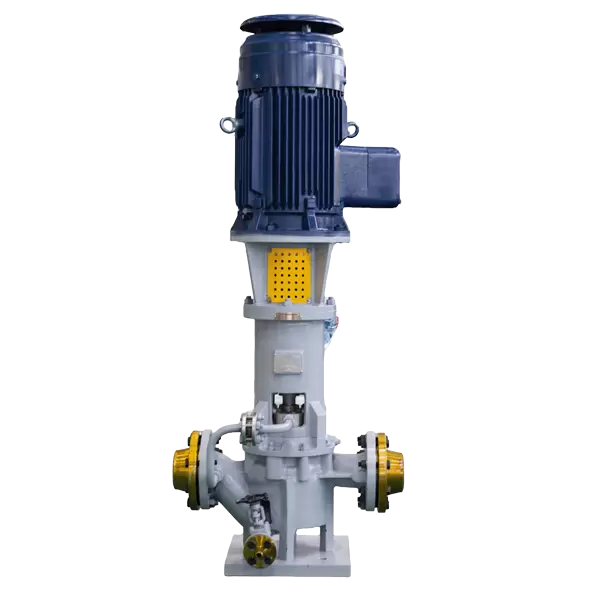
Designed for petroleum, petrochemical, and chemical processing operations, an API 610 OH3 pump combines a compact installation arrangement with heavy-duty mechanical construction. Its suction and discharge connections are positioned on the same horizontal axis, allowing the pump to fit into existing pipeline layouts more efficiently. For engineers planning new facilities or upgrading existing pumping equipment, this configuration can help reduce structural requirements and simplify installation planning.
How Vertical Inline Pump Design Optimizes Installation Space
One of the main advantages of an inline centrifugal pump is its ability to reduce the footprint required for installation. Unlike conventional horizontal equipment, the pump does not require a separate baseplate or extensive foundation arrangement. Its vertical orientation allows the motor and pumping components to occupy less floor area, making it particularly suitable for offshore platforms, refinery units, and process facilities with congested equipment layouts.
Another important consideration is pipeline integration. With suction and discharge nozzles arranged 180 degrees apart on the same horizontal plane, the pump can be installed directly within the piping route. This arrangement helps reduce unnecessary pipeline changes and provides greater flexibility when coordinating equipment positions during plant design.
Mechanical Construction and Hydraulic Performance
A reliable API 610 OH3 centrifugal pump requires more than a compact external structure. Its internal hydraulic components and mechanical support must withstand continuous operation, pressure fluctuations, and demanding process conditions.
The radial split volute casing provides structural strength and supports convenient access for inspection. Larger configurations can incorporate a double-volute arrangement to help balance radial hydraulic forces. The closed radial-flow impeller is dynamically balanced, while replaceable wear rings help manage internal clearance changes caused by normal operation.
The separate bearing housing is another important design consideration. Unlike simpler close-coupled arrangements, this construction provides dedicated support for pump thrusts. A rigid shaft design helps control deflection and vibration, contributing to stable mechanical performance and improved component service life.
Key Design Features and Their Operational Value
Design feature | Industrial benefit |
|---|---|
Vertical inline construction | Reduces installation footprint |
Radially split casing | Facilitates internal inspection |
Closed radial impeller | Supports stable hydraulic performance |
Separate bearing housing | Provides dedicated mechanical support |
Replaceable wear rings | Simplifies wear component maintenance |
Flexible sealing arrangements | Adapts to different process fluids |
API 682 seal options | Supports demanding sealing requirements |
Selecting the Right Mechanical Seal and Impeller Configuration
Different industrial liquids create different sealing and hydraulic challenges. Temperature, pressure, viscosity, corrosiveness, and the presence of suspended particles should all be considered before selecting pump components.
For demanding process duties, API 682 mechanical seals can be configured with single or dual arrangements and suitable flushing plans. Packing gland options may also be considered where appropriate. The final sealing configuration should reflect fluid characteristics, leakage control requirements, and operating conditions.
Impeller selection also influences performance. Closed impellers are suitable for many conventional process liquids, while semi-open and open configurations may be available for fluids with greater clogging potential. Matching the impeller structure to the liquid properties helps maintain hydraulic stability and reduces unnecessary maintenance.
Industrial Applications of OH3 Inline Centrifugal Pumps
Vertical inline pumps are used across several industries where reliable liquid transfer and efficient equipment arrangement are important. In oil and gas facilities, they can support refinery transfer, tank farm circulation, and utility services. Their compact installation arrangement is particularly valuable where multiple process pipelines and equipment units compete for limited space.
In chemical and petrochemical production, these pumps handle process feed, solvent circulation, and liquid transfer duties. Material selection and mechanical sealing become especially important when dealing with corrosive, hazardous, or temperature-sensitive fluids.
Other applications include auxiliary cooling water in power plants, condensate transfer, municipal water supply, booster services, HVAC circulation, and industrial firewater duties. High-temperature and low-temperature operating requirements should be evaluated alongside hydraulic performance to ensure that the selected construction is suitable for the intended service.
Important Considerations Before Purchasing an Industrial Inline Pump
Selecting an industrial pump requires a clear understanding of actual operating conditions rather than relying exclusively on maximum advertised capacity. Buyers should establish the required flow rate, discharge head, suction conditions, liquid temperature, and operating pressure before requesting a quotation.
Selection factor | What buyers should evaluate |
|---|---|
Hydraulic requirements | Flow rate, head, and operating range |
Liquid properties | Density, viscosity, and corrosiveness |
Installation conditions | Pipeline alignment and available space |
Mechanical requirements | Shaft support, bearings, and sealing |
Maintenance planning | Inspection access and spare parts |
Compliance | API 610 and applicable project standards |
It is equally important to consider operating efficiency throughout the expected duty range. A pump selected too far from its best efficiency point may experience increased vibration, hydraulic instability, and unnecessary energy consumption. Working with an experienced API OH3 pump manufacturer helps ensure that hydraulic selection, mechanical configuration, and installation requirements are considered together.
Kalen Provides Industrial Pump Solutions for Demanding Process Duties
Kalen focuses on industrial centrifugal pump manufacturing and customized fluid handling solutions. With more than 60 years of pump manufacturing experience, the company supports customers across oil and gas, petrochemical, chemical processing, power generation, and water treatment industries.
Its vertical inline process pump is designed in accordance with API 610 and ISO 13709 requirements. Different hydraulic configurations, material selections, and mechanical sealing arrangements can be considered according to project conditions. Kalen also provides technical support and global shipping services to help buyers coordinate equipment selection and procurement.
For industrial purchasers, choosing a suitable vertical inline centrifugal pump supplier means evaluating not only product construction but also engineering communication, manufacturing experience, quality control, and long-term service support. These factors contribute to more predictable procurement and reliable equipment operation.
Frequently Asked Questions
Q1: What is an API OH3 pump used for?
It is used for industrial process fluid transfer, particularly in petroleum, petrochemical, chemical, power generation, and water-related applications.
Q2: What is the main advantage of a vertical inline pump?
Its compact vertical arrangement allows direct pipeline installation, reducing floor space requirements and eliminating the need for a conventional baseplate foundation.
Q3: How does an OH3 pump differ from a conventional horizontal centrifugal pump?
The main difference is its vertical inline configuration, which places suction and discharge connections along the same horizontal axis and supports more compact installation.
Q4: Can an industrial inline pump handle corrosive liquids?
Yes, provided that suitable casing, impeller, shaft, and sealing materials are selected according to the liquid's chemical properties and operating conditions.
Q5: What information should buyers provide when requesting a quotation?
Buyers should provide flow rate, head, liquid properties, operating temperature, pressure, installation requirements, and applicable industry standards.